
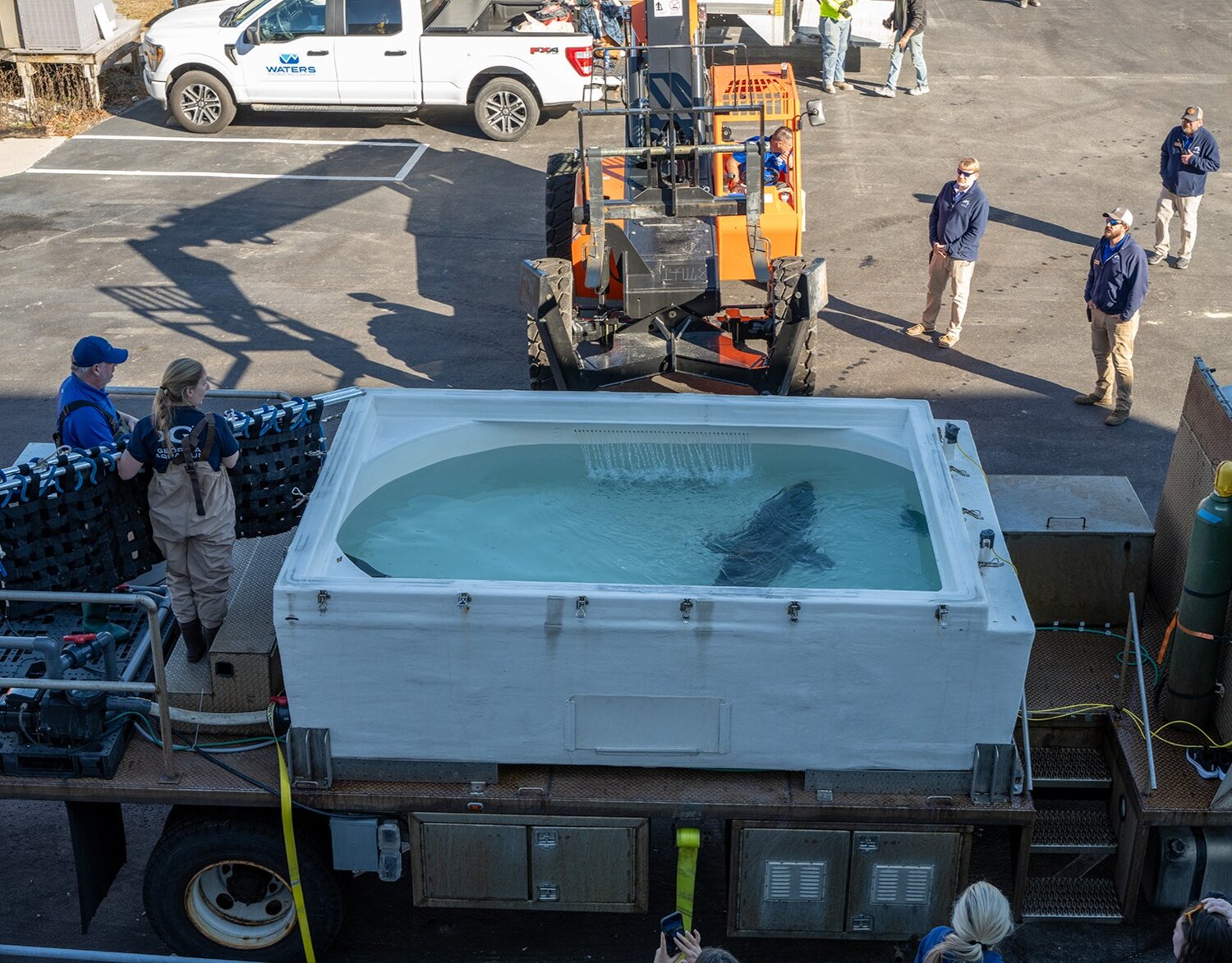
It’s not your ordinary relocation services when four aquariums come together to move two sand tiger sharks — a female weighing 282 pounds and a male weighing 165 pounds.
The NC Aquariums teams executed a well-rehearsed plan that initiated at the NC Aquarium at Fort Fisher (NCAFF) where the sharks first had to be secured in a special cargo net, then quickly attached to a telehandler (a versatile hydraulic lifting machine) and finally transported to a flatbed with a mobile aquarium. Georgia Aquarium provided the mobile aquarium and a crew to support the transport of the sharks.
The first stop was the NC Aquarium at Pine Knoll Shores (NCAPKS) where the team introduced the male shark into the Living Shipwreck habitat. From there, the Georgia Aquarium team traveled farther north to the NC Aquarium on Roanoke Island (NCARI) where the female shark is now gliding for the public to see in the Graveyard of the Atlantic.
The two sharks had been at NCAFF for almost a decade in the 235,00-gallon Cape Fear Shoals habitat. The Living Shipwreck is a 306,000-gallon habitat and Graveyard of the Atlantic is a 285,000-gallon habitat. The habitats will provide more space for the animals to thrive as they continue to grow.
“The transport of these two special sharks was amazing to watch,” said Joanna Zazzali, NCAFF director. “We are grateful for the excellent preparation and planning from everyone on the team to execute the transport as flawlessly as possible and especially appreciate the assist from our friends at the Georgia Aquarium.”
Prioritizing the sharks’ safe transport, the NCA veterinary team was on hand during every step of their journey from initial catch up at NCAFF to their arrival at NCAPKS and NCARI. Each team member worked with precision and speed — safely securing each shark, then gently placing them by telehandler into the mobile aquarium and finally, delivering them to their new homes. NCA veterinary and animal care teams rehearsed the process multiple times to ensure they could execute every step of the transport during a short window, limiting the sharks’ time out of the water.
Sand tiger sharks are a special conservation focus for the NC Aquariums, with each facility featuring them in their signature habits and sharing their story with visitors. These sharks, commonly found around NC shipwrecks, provide unique opportunities for divers to experience them in their natural habitats. The International Union for Conservation of Nature (IUCN) listed the sand tiger shark as Critically Endangered on the Red List in 2021 because of decreasing populations globally.
The NC Aquariums also collaborate with other major aquariums and conservation leaders on initiatives to support shark populations in the wild as an accredited member of the Association of Zoos and Aquariums (AZA). AZA is a non-profit organization dedicated to the highest standards in the areas of conservation, animal welfare, education, science and recreation. Initiatives include tagging projects and behavior studies, and Spot A Shark USA, a community science program that engages SCUBA divers in sand tiger shark research along the Atlantic coast.
Also, through participation in AZA SAFE: Shark & Ray (Saving Animals From Extinction), the Aquariums work together with other zoos and aquariums to save elasmobranchs (sharks, skates and rays) from extinction.
NC Aquariums is a division of the Department of Natural and Cultural Resources. To visit any of the aquariums, please reserve tickets online atncaquariums.com.


