
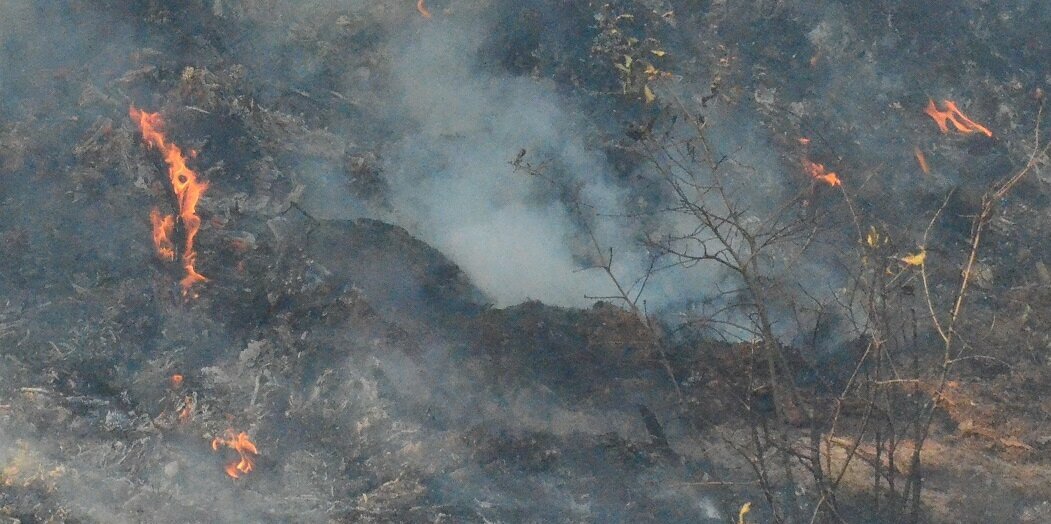
ROCKINGHAM — Smoke from a wildfire south of the city drifted through downtown early Friday afternoon.
The fire started from a property owner burning off his ditch on Hamer Mill Road, according to Ranger Brandon VanBuren with the N.C. Forest Service.
Van Buren said the fire quickly spread and was raging by the time crews arrived around 12:45, with flames shooting 10 feet and reaching the tree line.
Crews had the fire contained around 1:30 p.m. — after it burned around 5 acres. Three structures, including an abandoned house, were lost in the fire.
Although the winds were lighter than on Thursday, VanBuren said Friday was still a “high fire danger day” due to the relative humidity being down to 20%.
More than 20 counties in southeastern North Carolina, along with several counties in the west are labeled as having a very high probability of fire danger for Friday. There are also more than 20 counties in the central region and a few in the mountains that are labeled for extreme fire danger.
Richmond County is expected to remain in the high or very high probability for the next week.
Relative humidity has a direct correlation with the moisture of fuels including underbrush, leaves, sticks and pine straw, Van Buren said.
There have been several smaller wildfires across Richmond County recently, according to the NCFS Public Wildfire Viewer. Most have burned a half-acre or less, however there have been three to burn one acre on Watkins Loop Road, Stelleys Tabernacle Church Road and Airport Road (just north of the intersection with Gin Mill Road).
As of Feb. 26, there had been 1,431 wildfires across the state which burned 3,070 acres.
On Wednesday, 918.2 acres burned from 132 fires, with the majority — 21 fires, 498 acres — being in District 3 which includes Richmond, Anson, Chatham, Lee, Montgomery, Moore, Scotland and Stanly counties.
According to the Insurance Information Institute, North Carolina has the third-highest frequency of wildfires in the U.S., behind California and Texas, in 2023. However, several states in the west which saw fewer fires had more acres burned.
The North Carolina State Climate Office says there are two times a year when “we do tend to see increased fire activity… mainly driven by our temperatures and other environmental factors.” Those times are March-April and September-October.
The ranger discourages residents from burning until the relative humidity rises.


