HAMLET — Local law enforcement agencies are again urging residents to be wary of scam attempts.
On Monday, the Hamlet Police Department posted a warning to its Facebook page saying investigators “have worked several cases where individuals have targeted our citizens with financial scams.”
“Many of these scams have been around for months and even years, however, the suspects are very convincing, and some fall victim to their scams,” the post reads.
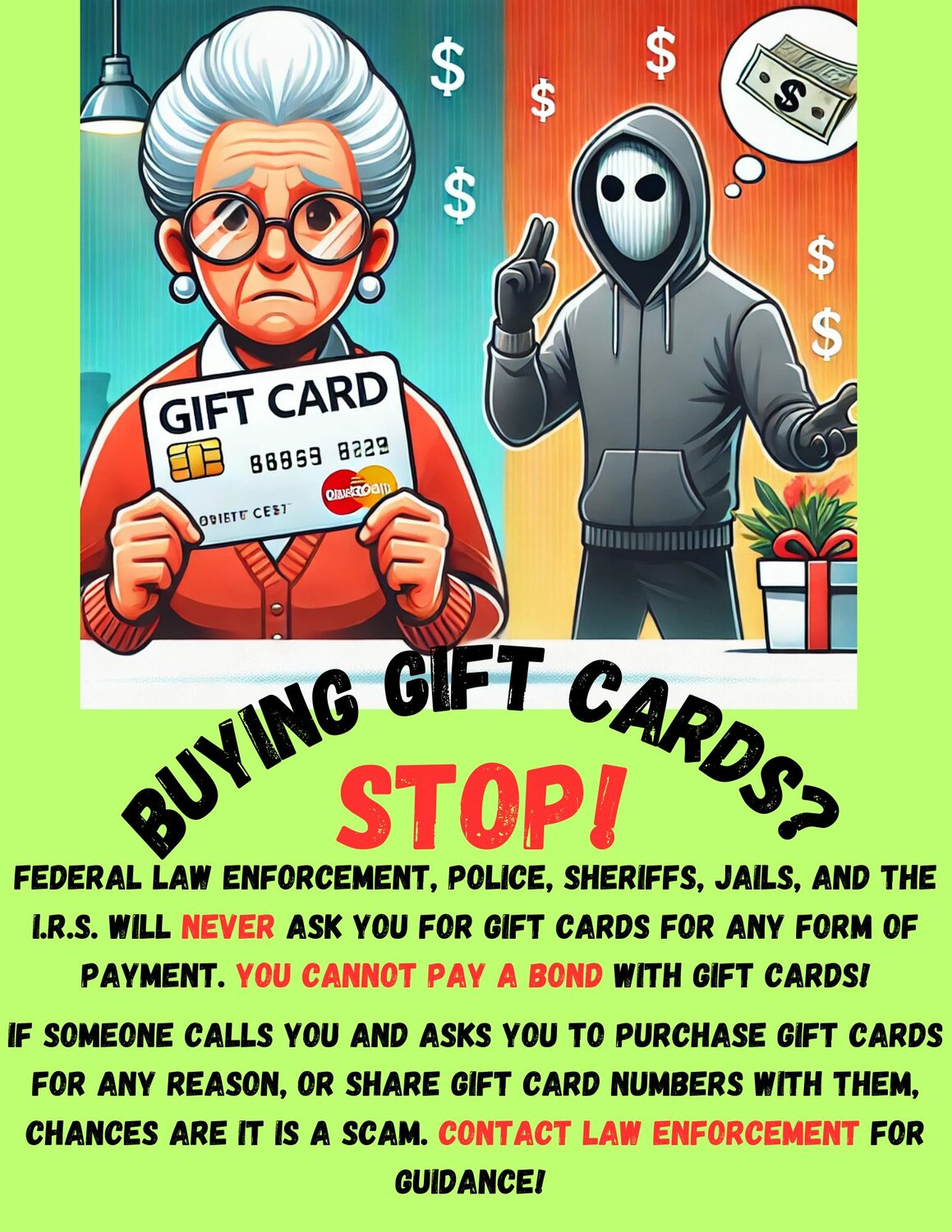
The post includes several graphics with tips on what to look for regarding scam attempts.
Maj. Hudson Chitwood said the goal of the graphics is for residents to “use the tools to defend themselves before it starts.”
The first graphic warns of gift card scams, noting that law enforcement agencies, jails and the IRS “will never ask you for gift cards for any form of payment.”
“If someone calls you and asks you to purchase gift cards for any reason, or share gift card numbers with them, chances are it is a scam,” the graphic reads.
Government agencies like the Federal Trade Commission and IRS and retailers like Walmart, Amazon and Apple have web pages dedicated to scam prevention.
According to the FTC, common scams involve the scammer pretending to be from the government, tech support, a utility company or a friend or family member who needs help.
In the latter case, scammers can use voice cloning.
“Also known as voice cloning, these technologies emulate recognizable voices for robocalls to consumers and are often used in imposter scams that spread misinformation, endorse products, or steal money and personal information,” reads a post from the Federal Communications Commission. “Scammers may try to fool an unsuspecting grandparent that a grandchild is in trouble and needs immediate financial assistance or solicit donations to a fake charity endorsed by what sounds like a trusted celebrity.”
The FTC says perps have also: used dating websites to bilk victims out of money in online romance scams; told victims they have won a prize but need to pay fees with a gift card; and sent checks for more than expected, instructing victims to deposit the check and purchase a gift card for the difference.
According to the Richmond County Sheriff’s Office, investigators have dealt with prize scams, where the scammer will have the victim purchase multiple cards.
RCSO has also received reports regarding text messages about toll collections, about which the N.C. Attorney General’s office recently issued a press release.
One Hamlet resident fell victim to a relative-in-trouble scam earlier this year, according to investigators.
 Bryan Buonjiovanni is accused of scamming a Hamlet resident out of $16,000 in January.
RCSO
Bryan Buonjiovanni is accused of scamming a Hamlet resident out of $16,000 in January.
RCSO
Bryan Buonjiovanni, 19, of New Brunswick, Canada, is accused of being involved in a scam of posing as the victim’s grandson, claiming to be in jail. Police are not sure if voice cloning was used.
Investigators say Buonjiovanni convinced the victim to withdraw $16,000 for bail on Jan. 29 and meet a courier at Hardee’s. The defendant allegedly met with the victim and took off with the money.
The transaction was caught on surveillance video and Buonjiovanni’s vehicle was captured by a Flock Safety camera, police say. He reportedly was stopped by police in Monroe two days later for a traffic violation.
Investigators charged Buonjiovanni with one felony count of obtaining property by false pretenses. He has been held in the Richmond County Jail since Feb. 7 on a $200,000 secured bond.
Investigators say Buonjiovanni declined to make a statement.
Court records show his next court date is scheduled for April 10.
All defendants facing criminal charges are presumed innocent until proven guilty in a court of law.
HPD reportedly had a similar case last week, where the victim was supposed to meet a courier — who investigators say wound up being a Lyft driver hired for a pick-up and was not involved with the scam.
The N.C. Attorney General’s office offers the following tips to avoid becoming a scam victim:
The HPD also encourages residents to create a secret family word as a scam deterrent.
Anyone suspecting scam activity is encouraged to file a complaint with their local law enforcement agency; contact the N.C. Consumer Protection Division at 1-877-5-NO-SCAM; or file a complaint with the FCC or FTC.